
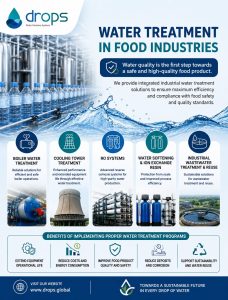
Water Treatment in the Food Industry: Ensuring Product Quality, Operational Efficiency, and Regulatory Compliance
Introduction
Water is one of the most critical raw materials in the food industry. It is involved in nearly every stage of production, from washing raw ingredients and food processing to cleaning, sanitization, steam generation, and cooling operations. Because of its extensive use throughout manufacturing processes, maintaining appropriate water quality is essential to ensuring product safety, protecting equipment, and optimizing operational efficiency.
Different applications within food processing facilities require specific water treatment approaches tailored to their operational requirements and quality standards.
The Importance of Water Treatment in Food Manufacturing
Untreated water can introduce several operational and product-quality challenges that directly impact production efficiency and food safety.
Common water quality issues include:
Dissolved Salts
Calcium and magnesium ions contribute to scale formation inside pipelines, boilers, and heat exchangers. These deposits reduce heat transfer efficiency, increase energy consumption, and may negatively affect product taste and texture.
Iron and Manganese
Excessive concentrations of iron and manganese can cause discoloration, undesirable flavors, and quality defects in food and beverage products.
Excess Chlorine
While chlorine is commonly used for disinfection, elevated concentrations may alter product flavor profiles and damage sensitive food ingredients.
High Water Hardness
Hard water significantly reduces the efficiency of boilers and cooling towers while increasing maintenance requirements and operating costs.
Boiler Water Treatment in Food Processing Plants
Boilers are essential components in food manufacturing facilities, producing steam required for cooking, sterilization, heating, and operation of various processing systems.
Due to continuous exposure to high temperatures and challenging water conditions, boiler systems are particularly vulnerable to three major problems:
- Scale Formation
- Corrosion
- Foaming and Carry-over
Failure to control these issues can lead to increased fuel consumption, reduced steam quality, equipment failure, and unplanned production downtime.
Key Stages of Boiler Feed Water Treatment
To achieve the required water quality specifications, boiler feed water typically undergoes several treatment stages:
1. Pre-Filtration
Removal of suspended solids and turbidity using multimedia sand filters and activated carbon filters.
2. Water Softening Using Ion Exchange Resin
Ion exchange resin systems replace hardness-causing calcium (Ca²⁺) and magnesium (Mg²⁺) ions with sodium (Na⁺) ions, preventing scale formation within boiler systems.
3. Dissolved Oxygen Removal
Oxygen is one of the primary causes of corrosion in boiler systems. In food industry applications, food-grade approved oxygen scavengers are recommended.
4. pH Control
Maintaining boiler water pH between 10.5 and 11.5 helps minimize corrosion. Advanced treatment programs such as Helamin technology can provide additional corrosion protection throughout the steam-water cycle.
5. Blowdown Control
Proper blowdown management prevents excessive accumulation of dissolved solids and maintains water chemistry within acceptable operating limits.
Economic and Environmental Benefits of Water Treatment
Although water treatment systems require an initial investment, their long-term financial and environmental benefits significantly outweigh implementation costs.
Reduced Fuel Consumption
Even a 1 mm scale layer can increase fuel consumption by approximately 7–10%. Effective water treatment prevents scale formation and maintains optimal heat transfer efficiency.
Extended Equipment Life
Proper treatment programs can extend the operational life of boilers, cooling towers, membranes, and associated equipment by two to three times.
Lower Maintenance Costs
Reducing scale and corrosion minimizes cleaning requirements, repair expenses, and production interruptions.
Condensate Recovery and Reuse
Recovering and reusing 70–80% of boiler condensate significantly reduces energy consumption because condensate is already hot, treated, and of high purity.
Environmental Compliance
Proper treatment ensures compliance with wastewater discharge regulations and environmental standards, reducing the risk of penalties and regulatory issues.
Competitive Advantage
Organizations that implement sustainable water management practices strengthen their corporate image and support environmental certification programs, enhancing market competitiveness.
Cooling Tower Water Treatment
Cooling Tower Operation in Food Processing Facilities
Cooling towers are widely used to remove heat from warm process water returning from heat exchangers, condensers, refrigeration systems, and production lines.
The cooling process relies on specially designed fill media that increases water retention time and maximizes heat transfer between water and air, allowing efficient cooling before the water is recirculated back into the system.
Proper cooling tower water treatment is essential to prevent scale formation, corrosion, microbiological growth, and efficiency losses.
Ion Exchange Resin Technology
How Ion Exchange Resin Works
Ion exchange resin is a porous polymer material containing fixed electrical charges and exchangeable ions.
As water passes through the resin bed, undesirable ions in the water are exchanged with ions attached to the resin, allowing selective removal of specific contaminants.
Applications of Ion Exchange Resin in the Food Industry
Boiler Feed Water Softening
The most common application, producing hardness-free water and preventing boiler scale formation.
Nitrate Removal
Specialized selective anion resins are used to remove nitrates from production water where required.
Support for Advanced Water Treatment Systems
Ion exchange technology is frequently integrated with filtration and activated carbon systems to achieve higher water quality standards required by food processing facilities.
Conclusion
Water quality directly impacts food safety, product consistency, equipment reliability, and operational costs. Implementing an effective water treatment strategy is not merely a regulatory requirement—it is a critical investment in product quality, production efficiency, and long-term sustainability.
For food manufacturers seeking to improve operational performance while maintaining the highest quality standards, a properly designed water treatment program remains one of the most valuable assets within the production process.