The Engineering Meaning of Each Coupon and How to Choose It
The Basic Rule
The coupon alloy must exactly match the metal of the piping or heat exchangers at the point being monitored (Matching Metallurgy). The coupon represents the system metal and shows how it reacts to the water and to the chemical treatment program.
How It Works
- A corrosion coupon is a standardized metal specimen, pre-weighed to 0.0001 g with a unique serial number.
- It is exposed to the system water (Cooling Water / Boiler / Closed Loop), typically 30–90 days, then retrieved, cleaned and re-weighed.
- Corrosion Rate (mpy) = (W × 534) ÷ (D × A × T), where W is weight loss (mg), D is density (g/cm³), A is area (in²) and T is time (hr), per ASTM G1.
- The coupon records the effect of water conditions over the whole exposure period, so it is a reliable early indicator, not a real-time reading.
The Coupons and Their Benefits
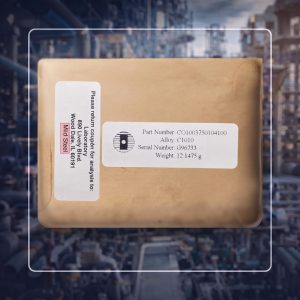
1 – Mild Steel C1010
Code: CO1003750104100
Represents: Low-carbon steel (UNS G10100), the metal of most industrial water lines, cooling tower structures and boiler systems.
Benefit: The main yardstick for the General Corrosion Rate of carbon steel and the first indicator of treatment-program efficiency and corrosion inhibitor success (Phosphonate, Zinc, Molybdate, Orthophosphate).
Engineering note: The reading applies to the installation point; complete it with Pitting and Under-Deposit Corrosion examination.
2 – Pre-Treated Mild Steel
Code: P5054A
Represents: Carbon steel with a pre-conditioned surface (M.S. Pre-Treated).
Benefit: Reduces scatter in the starting surface condition between coupons, making comparisons between treatment programs or monitoring points more precise and repeatable.
Engineering note: The treatment type is not printed on the label; confirm it from the supplier specification.
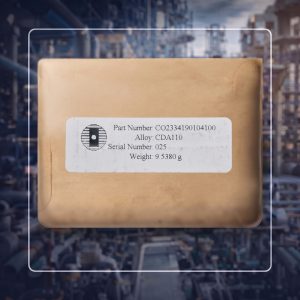
3 – Copper CDA110
Code: CO2334190104100
Represents: Copper (UNS C11000, Cu ≥ 99.9%) in chillers, heat exchangers and condensers.
Benefit: Monitors copper sensitivity to oxidizers (Oxidizing Biocides such as chlorine and bromine) and confirms the effectiveness of copper inhibitors (Azoles such as Tolyltriazole).
Engineering note: Reveals Cu²⁺ release, a main cause of Galvanic Corrosion of steel and aluminum elsewhere in the system.
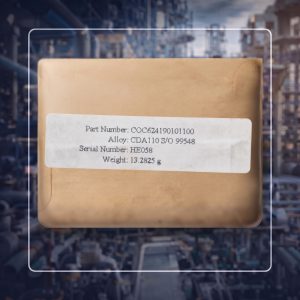
4 – Copper CDA110 (second version)
Code: COC624190101100
Represents: Same alloy and same application.
Benefit: Same benefits, but the weight is 13.2825 g vs. 9.5380 g for the previous code, i.e. different standard dimensions.
Engineering note: Choose the code that matches your Coupon Holder.
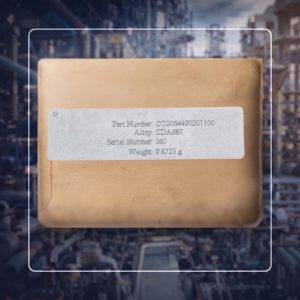
5 – Aluminum Brass CDA687
Code: CO2064490201100
Represents: Cu 76–79% / Al 1.8–2.5% / As 0.02–0.06% / Zn (balance), used in seawater, brackish water and high-velocity heat exchangers.
Benefit: Monitors system resistance to attack from water impact and flow velocity (Impingement / Erosion-Corrosion), and evaluates high-salinity environments.
Engineering note: Arsenic inhibits Dezincification, and aluminum forms a protective oxide film.
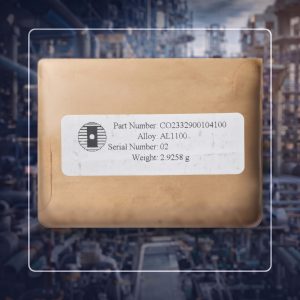
6 – Aluminum AL 1100
Code: CO2332900104100
Represents: Commercially pure aluminum (UNS A91100, Al ≥ 99.0%) in heat exchanger fins, tanks and aluminum components.
Benefit: Aluminum is Amphoteric and highly sensitive to high or low pH, so it works as an accurate early indicator of water quality before the actual aluminum equipment is damaged.
Engineering note: Also affected by chlorides and copper plating-out. It is the reference for pure aluminum.
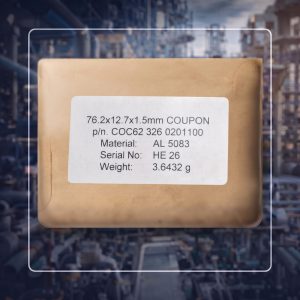
7 – Aluminum AL 5083
Code: COC62 326 0201100
Represents: Marine Al–Mg alloy (Mg ≈ 4.0–4.9%), size 76.2 × 12.7 × 1.5 mm.
Benefit: The same pH and chloride monitoring principle, for higher-strength aluminum parts and marine applications.
Engineering note: Supplied in a VCI-Impregnated Envelope (Volatile Corrosion Inhibitor) to protect it in storage.
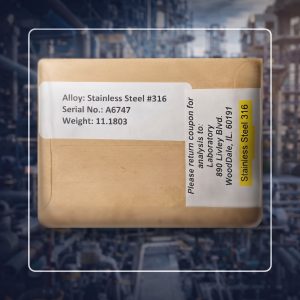
8 – Stainless Steel 316
Code: Serial A6747 (label carries no Part Number)
Represents: Stainless steel 316 (UNS S31600: Cr 16–18% / Ni 10–14% / Mo 2–3%) in critical equipment, pumps and piping.
Benefit: Not used to measure general weight loss, because a passive metal loses very little weight; it is used to detect and monitor Pitting and Crevice Corrosion.
Engineering note: These are dangerous localized corrosion forms, appearing as deep needle-like holes, and become active when chlorides (Cl⁻) rise. Evaluated by pit depth examination per ASTM G46.
How to Choose the Right Coupon
- Carbon steel: C1010, or Pre-Treated for precise comparisons.
- Copper and copper exchangers: CDA110.
- Seawater, high salinity or high velocity: CDA687.
- Aluminum: AL 1100 for pure aluminum, AL 5083 for the marine alloy.
- Stainless steel: SS 316.
- Mixed Metallurgy systems: several types on the same Coupon Rack.
Mount the coupons on Insulated Holders inside a Coupon Rack on a Bypass line, to avoid Galvanic Corrosion between dissimilar coupons.