Advanced Surface Protection for Industrial Water Systems
Boilers | Cooling Towers | Chillers & Closed-Loop Systems
Executive Overview
Corrosion is a persistent operational risk in industrial water systems. It can reduce equipment reliability, increase maintenance requirements, contaminate process streams with corrosion products, and contribute to unplanned shutdowns. Film-forming amine (FFA) technology offers a surface-oriented approach to corrosion management: selected molecules adsorb onto compatible metal surfaces and form a thin, water-repellent film that can help limit interaction between the metal and its surrounding environment.
When correctly selected and integrated into a complete water treatment strategy, FFA technology can support corrosion control in specific boiler and condensate circuits and in selected cooling or closed-loop systems. Success depends on understanding the system, confirming compatibility, applying the product correctly, and verifying performance through monitoring.
1. What Are Film-Forming Amines?
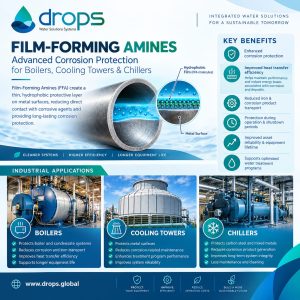
Film-forming amines are surface-active organic compounds used in certain industrial applications to provide corrosion protection. Their molecular structure typically includes a part with an affinity for the metal surface and an organic portion that contributes to the hydrophobic (water-repellent) character of the adsorbed layer.
After introduction into a compatible system, active molecules can migrate to and adsorb onto available metal surfaces. The resulting film is microscopic; it is not a conventional paint, lining, or thick coating. Its purpose is to modify the metal–water interface and reduce direct exposure of the surface to corrosive species.
2. How Does the Protective Film Work?
The general mechanism can be understood in three stages:
- Adsorption: active molecules are transported through the system and attach to compatible metallic surfaces.
- Film formation: adsorbed molecules form a thin hydrophobic layer that can reduce direct contact between the metal and the aqueous environment.
- Film maintenance: under suitable operating conditions, an appropriate treatment concentration and distribution help maintain or replenish the protective layer.
Actual performance depends on product chemistry, metallurgy, surface condition, water composition, temperature, flow, contamination, and dosing strategy. Different products marketed as FFAs are not interchangeable; application-specific product guidance and compatibility data are essential.
3. Industrial Applications
A. Steam Boilers & Condensate Systems
Boiler and condensate circuits can face corrosion risks associated with dissolved oxygen, carbon dioxide, unsuitable pH, contaminant ingress, and operating or shutdown conditions. Certain film-forming products are specifically formulated for steam and condensate applications and may provide additional surface protection throughout compatible parts of the circuit.
- Support corrosion control on compatible metal surfaces in boiler and condensate circuits.
- Help reduce corrosion-product transport, including iron, when correctly applied.
- Provide supplementary surface protection during selected operating, standby, or shutdown conditions.
- Support equipment reliability as part of a complete boiler-water and condensate management program.
FFA treatment does not remove the need for sound feedwater preparation, oxygen management, appropriate pH control, blowdown management, or steam-purity protection. Product selection must consider boiler pressure, metallurgy, steam use, applicable standards, and manufacturer recommendations.
B. Cooling Towers & Open Recirculating Systems
Open cooling towers operate under continuous oxygen exposure and changing water chemistry. Concentration cycles, dissolved salts, temperature variations, deposits, and microbiological activity can influence corrosion behaviour. Some film-forming inhibitor formulations may be suitable for specific open recirculating systems, but suitability must be demonstrated for the actual application.
- Contribute to corrosion protection of compatible metallic surfaces.
- Help manage corrosion-related metal loss and maintenance requirements.
- Complement conventional corrosion and scale-control programs when compatibility is confirmed.
- Support reliable operation of cooling-water circuits and associated heat-transfer equipment.
Treatment design should review cycles of concentration, pH, alkalinity, hardness, chloride, conductivity, metallurgy, biocide program, scale inhibitor, filtration, and discharge requirements. An FFA intended for a closed circuit or condensate system should not automatically be assumed suitable for an open cooling tower.
C. Chillers & Closed-Loop Cooling Systems
Closed-loop chilled-water systems may still experience corrosion due to oxygen ingress, initial fill quality, leakage, maintenance activities, and mixed metallurgy. A suitable inhibitor program helps protect piping, pumps, heat exchangers, and other components.
- Support protection of compatible carbon-steel and other approved metal surfaces.
- Help limit corrosion-product generation and circulation through the system.
- Contribute to long-term system integrity and operational reliability.
- Complement a closed-loop treatment program designed for the system’s water quality and materials.
Confirm compatibility with all relevant materials, which may include carbon steel, copper alloys, stainless steel, aluminium, seals, and elastomers. Product suitability should also be checked against operating temperatures, system volume, existing inhibitors, and equipment requirements.
4. Operational & Business Benefits
The value of an FFA program should be assessed in terms of corrosion control and whole-system performance—not chemical consumption alone. Depending on the application and verified results, a properly designed program may contribute to:
- Improved corrosion protection through surface film formation.
- Lower corrosion-product transport and reduced iron-related contamination where applicable.
- More reliable operation of protected equipment and associated piping.
- Reduced corrosion-related inspection, cleaning, repair, and maintenance demands.
- Additional protection during selected shutdown or layup conditions, where approved.
- Support for maintaining heat-transfer performance by controlling corrosion and associated deposits.
Heat-transfer performance is also influenced by scale, fouling, flow, equipment condition, and operating load. FFA treatment should not be presented as a guaranteed energy saving or a fixed percentage improvement. Any energy-efficiency claim should be supported by application-specific measurements taken before and after treatment under comparable operating conditions.
5. Engineering Considerations Before Implementation
A successful FFA program begins with a technical review and continues with controlled commissioning and routine monitoring. Key considerations include:
- System review: operating conditions, design, circulation pattern, system volume, metallurgy, and critical equipment.
- Water analysis: pH, conductivity, dissolved solids, hardness, alkalinity, chloride, dissolved oxygen where relevant, and other application-specific parameters.
- Condition assessment: existing corrosion, deposits, fouling, and the history of treatment or contamination events.
- Compatibility: interactions with scale inhibitors, oxygen scavengers, biocides, dispersants, cleaning chemicals, and construction materials.
- Application method: dosing point, concentration, distribution, start-up procedure, and product-specific instructions.
- Performance monitoring: iron or copper trends where relevant, corrosion coupons or probes where appropriate, water chemistry, inspections, and operating data.
In older systems, introducing a surface-active treatment may coincide with the release or transport of loosely adherent corrosion products already present in the circuit. This possibility should be considered during commissioning through baseline sampling, controlled application, and appropriate monitoring. An increase in measured iron should be investigated rather than automatically attributed to either new corrosion or the treatment.
Film-forming technology is one element of a corrosion-control strategy. It should not automatically replace essential measures such as oxygen control, pH management, scale inhibition, microbiological control, filtration, or good mechanical practice.
6. The Drops Approach
At Drops – Water Solutions Systems, we approach industrial water treatment as an engineered service, not simply a chemical supply activity. Our objective is to match the treatment program to the actual system, its operating conditions, and the customer’s performance requirements.
- Technical assessment and water analysis.
- Application-specific boiler, cooling tower, and closed-loop treatment programs.
- Chemical selection and dosing-system recommendations.
- Monitoring of key water-quality and corrosion indicators.
- Technical follow-up and performance reporting.
By combining suitable treatment chemistry with sound engineering, monitoring, and operational follow-up, Drops helps customers protect critical assets, manage corrosion risks, and support reliable industrial operations.
Conclusion
Film-forming amines provide a surface-based approach to corrosion protection that can add value in selected industrial water applications. Their effectiveness depends on choosing the right formulation for the right system, confirming compatibility, applying the product correctly, and monitoring the results. Integrated with a complete water treatment strategy, FFA technology can support equipment protection, operational reliability, and more effective maintenance planning.